Lily

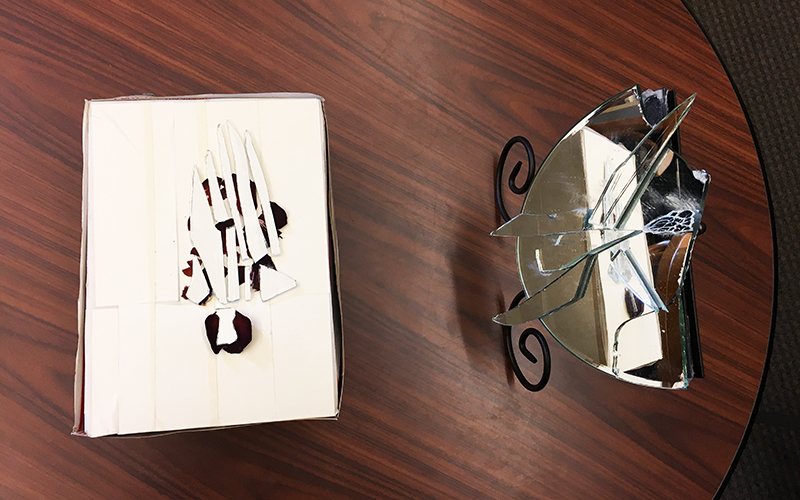
In this multipiece sculpture, I have recreated the physical scene taking place amidst the narrator’s inner monologue in Fedor Dostoevsky's “The Meek One”: the narrator standing over the dead body of his young wife on a table. Through this piece I probe into the narrator’s desire for his wife, and how rather than a direct desire, or even a mimetic desire for his wife mediated by another outside factor, his is a mimetic desire for himself, mediated by his young wife and her perceived purity. Both figures are plated in mirrored glass, as to create an endless chain reflective of the egoism of seeing another only to see oneself, but while the glass of the meek one is nearly spotless, and thus able to return the reflection of the husband looking down onto her, the glass of the narrator, particularly his face, is cracked and jagged, as to make it impossible for him to return the reflection of his wife in the same pure way as she has returned his: where his self is mediated and affirmed through the meek one’s reflection, hers is not afforded this same possibility. It is a fundamentally one-sided desire.
The narrator figure is mounted on a larger cracked mirror: the ego that drives his need to see himself reflected from a wider possible angle in the face of his wife. His ego, furthermore, is cracked in the shape of a broken egg as to recall infertility, underscoring the impossibility of a mutual relationship between the two figures so long as that egotistical desire to be affirmed through another, and not learn anything about that other, is perpetuated. In this case, it will be perpetuated forever, as the wife is now dead and neither figure is made of living or once-living material (mirror).
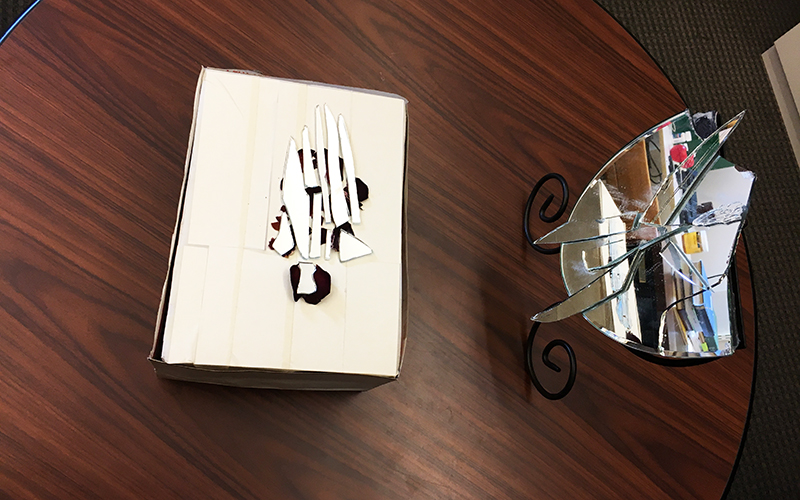
Amidst her being used for the mimetic self-desire of the narrator, the meek one maintains her sense of self. She, despite her title, is not particularly “meek” is the face of her husband, arguing with him for his moral wrongs of refusing to give a higher price for an old, poor woman and even chastising him for his lack of courage in refusing a duel years before. The meek one’s sense of self and cunning are never recognized in earnest by the narrator, and neither are they here.
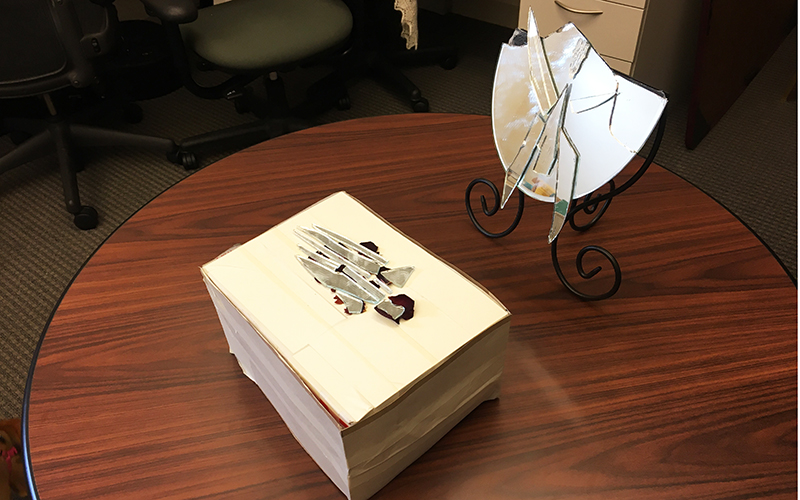
While the meek one’s body is in part made of reflective mirrored glass, it is also made of dried red rose petals, which, while they might have been reflected by the narrator in his own glass, cannot due to his face being so jagged. Rather, he sees only himself in her, and misses the petals, red roses for the passion and fiercely committed love with which she treats not her husband, but herself in refusing to be meek in the face of ill treatment. This scene reflects perhaps her biggest stand: disallowing him to use her for his ego any longer, or at the very least refusing to bear witness to this act, by committing suicide. In death, as in life, the meek one’s fidelity and love for herself are obscured to her husband, and unlike the unbroken reflective chain of his ego, will eventually decay with her husband never recognizing its existence.